Monster Shooter: Survival FPS
- 4.4
- Rating
- 50.00M
- Installs
- Free
- Price

 Analysis by App-foxy
I went into Monster Shooter: Survival FPS expecting a straightforward action game built around one clear idea: pick up a weapon, face waves of monsters, and stay alive for as long as possible. That expectation is important because this is not trying to be a slow, story-heavy adventure. Its appeal comes from immediate pressure, readable danger, and the satisfaction of handling a crowded fight without losing control.
After spending time with it, I see a game that works best in short, focused sessions. It gives the familiar monster-shooter formula a compact mobile shape, making it easy to start when I have a few spare minutes. At the same time, that simplicity creates a clear trade-off: players looking for deep character development, a large narrative world, or highly technical competitive combat may find the experience too narrow.
The game is free, belongs to the action category, and is made by Unicorn Studio Official. Its Teen content rating is a useful signal for families deciding whether it suits a younger player. It first appeared on December 7, 2022, and the current version is 1.0.90, with support beginning at Android 7.1. That broad device compatibility makes it approachable, although the exact feel will still depend on the phone or tablet being used.
You May Also Like

 Blood Strike: 2.5 Anniversary
Blood Strike’s Loadouts Turn Every Drop Into a Tactical Gamble
A close look at Blood Strike’s custom loadouts: how fast access to signature weapons reshapes its battle royale rhythm, rewards preparation, and narrows the gap between fights.

 Pandora - Music & Podcasts
Pandora’s Music Is Easy to Start, but Harder to Recover
Pandora’s strength is its low-effort path from a seed to a station. Its weak spot is how much confidence it asks you to place in connection, setup, and quiet recovery.

 8 Ball Pool
 Is Built on Rivalries, Rematches, and Routine
A close look at the rivalries, rematches, shared routines, and unanswered safety questions that turn a quick pool match into a persistent mobile community.

 Samsung Music
’s Quiet Strength Is Playing What You Already Own
Its reach comes less from spectacle than from dependable access to a personal library. That simplicity is both the app’s strongest retention engine and its ceiling.

 AccuWeather: Weather Radar
AccuWeather Review: A Quick, Clear Forecast for Everyday Decisions
For everyday plans, the best forecast is the one you can understand quickly. AccuWeather makes rain timing, radar, and local conditions easy to act on, with a few trade-offs.

 Hill Climb Racing
Why Hill Climb Racing Still Turns Crashes Into One More Run
A tiny car, a bumpy hill and one more upgrade: Hill Climb Racing keeps resurfacing because its simple chaos makes every near-miss feel personal.
More From Our News Desk



My first impression: quick danger with little ceremony
The strongest part of the opening experience is how quickly it gets to the central activity. There is no need to learn a complicated fictional universe before enjoying the action. The basic question is always easy to understand: where are the monsters, what weapon can I use, and how long can I keep moving without being overwhelmed?
That directness is valuable on a phone. I can imagine opening it during a short break, playing a concentrated run, and closing it without feeling that I have abandoned a long conversation or forgotten a complicated objective. The design is built around immediate engagement rather than a large amount of preparation.
For me, the first few encounters also establish the game’s intended mood. The setting exists to frame the threat, while the monsters provide the visual focus. This is a practical style of presentation: the player’s attention stays on movement, targets, and survival instead of being pulled toward decorative details that do not affect the next decision.
That focus can be refreshing, but it also means the game asks the player to create much of the personal meaning. There is less reason to care about an individual hero or a long-term story than there is in a campaign-driven shooter. The motivation is more immediate: improve your handling of pressure, make a cleaner attempt, and last longer when the screen becomes busy.
The game has attracted a substantial mobile audience, with over fifty million installs and an average rating of 4.4 from roughly sixty-four thousand ratings. Those figures do not guarantee that every player will enjoy it, but they do suggest that its uncomplicated survival-shooter structure is easy for many people to understand. I think that accessibility is one of its defining strengths.
A good fit for short sessions
My most realistic use case would be a player waiting for an appointment or taking a short evening break. This is the kind of game I would choose when I want action without committing to a full campaign chapter. The premise is simple enough to remember immediately, and the pressure of monster encounters gives even a brief session a clear purpose.
It is less suitable for someone who wants a calm game to play while multitasking. The moment-to-moment danger demands attention, especially when several threats approach at once. Looking away for only a little while can turn a manageable position into a bad one. That makes it a better choice for active play than for background entertainment.
How the world communicates danger without overexplaining
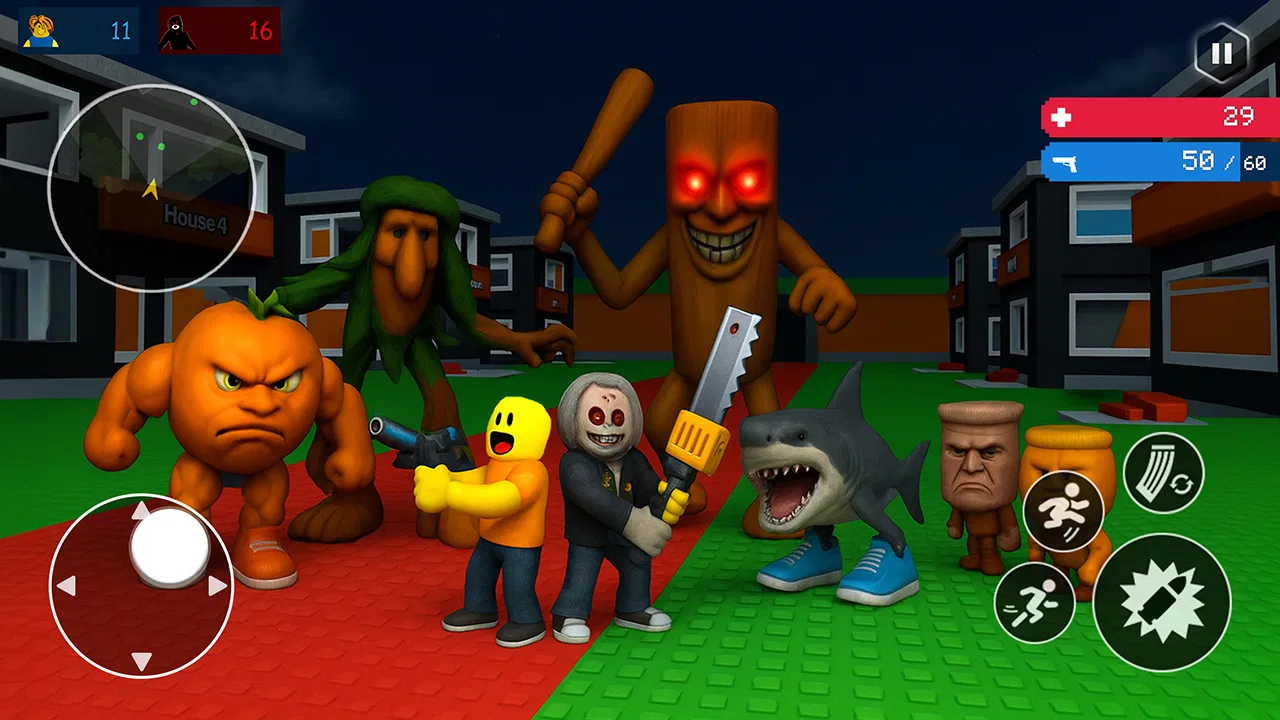
The art direction works because it supports the survival premise instead of competing with it. A monster shooter needs enemies that can be recognized quickly, and the visual language here is built around that basic readability. I do not need to study a detailed scene to understand where the danger is coming from.
This approach creates a coherent playable mood. The world feels like a hostile space first and a sightseeing destination second. Weapons and monsters carry much of the visual responsibility, while the surrounding setting reinforces the idea that safety is temporary. Even when the presentation is straightforward, that consistency helps the action feel connected to its environment.
One useful habit is to treat the scenery as part of the combat information rather than as decoration. When I enter a new area or face a denser group, I pay attention to how much room I have to move and which visual elements might make a threat harder to notice. In a survival-focused game, awareness of space can matter as much as aiming speed.
This is also where the game differs from more elaborate alternatives. A traditional story-led first-person shooter may use cinematic scenes, named characters, and carefully staged missions to create emotional momentum. Monster Shooter: Survival FPS is more economical. Its mood comes from repetition under pressure: the same basic promise becomes tense because the situation keeps becoming harder to control.
That economy is not automatically a weakness. I often prefer a game that makes its purpose clear over one that surrounds a simple combat loop with unnecessary explanation. However, players who need a strong narrative reason to continue may eventually feel that the setting is a backdrop rather than a world they can truly explore.
Why visual simplicity helps, and where it stops helping
Clear visual priorities are especially useful on a smaller screen. If the scene were overloaded with fine detail, it would be harder to distinguish a threat from the background during a hectic moment. The game’s direct presentation leaves more mental space for the decisions that actually matter: repositioning, choosing a target, and avoiding being boxed in.
The trade-off is that visual discovery has limited importance. I would not recommend this to someone choosing a mobile game mainly for rich environmental storytelling or a constantly changing sense of place. Its setting is successful as a pressure chamber, not necessarily as a destination that rewards slow examination.
There is also a practical lesson here: brightness and screen size can affect how comfortable the experience feels. Since the action depends on recognizing enemies quickly, a dim display or a cramped screen may make busy encounters more tiring. That is not a special feature or a hidden setting; it is simply a reason to play with the display comfortable and unobstructed rather than treating the game as something to glance at casually.
Sound, pacing, and the feeling of being surrounded
The audio direction matters because the game’s story is mostly told through action. When there is little narrative interruption, sound helps mark the rhythm of danger. Weapon feedback, enemy presence, and the general intensity of an encounter all contribute to whether a fight feels controlled or close to collapse.
I find that the best way to appreciate this design is to play with enough volume to notice changes in the action, while still keeping the sound comfortable for longer sessions. If the audio is muted, the game can feel flatter because some of the warning and impact behind each encounter disappears. On the other hand, players who need complete silence may prefer a different kind of mobile game, since the atmosphere loses some of its force without audio.
The pacing is deliberately functional. It does not rely on long stretches of exploration before delivering the main activity. Instead, the experience is shaped by escalation: a manageable situation becomes more crowded, and the player must maintain composure as the margin for error shrinks.
That rhythm makes the game easy to understand but not always easy to relax into. A short run can feel satisfying because every moment contributes to survival. It can also become repetitive for players who need frequent changes in objective, scenery, or play style. The game’s mood comes from refining the same core response rather than constantly introducing a new one.
How I manage the rhythm during a run
I get better results when I resist the urge to fire at the closest monster automatically. The more useful question is which threat is about to remove my escape route. Clearing a path or creating breathing room can be more valuable than focusing on the enemy that is already safely at a distance.
Another practical adjustment is to avoid treating every open area as a place to stand still. Movement is not just a way to dodge; it is how I preserve options for the next few seconds. If I allow enemies to close in from several directions, the weapon becomes less important than the lack of space around me.
This is one of the game’s less obvious strengths. The simple premise gives room for small tactical improvements. I can play aggressively when the field is clear, then switch to safer positioning when the crowd thickens. That change in attitude creates variety even when the overall objective remains the same.
Where the mechanics fit the mood
The mechanics and presentation generally point in the same direction. The action is about surviving a hostile encounter, and the controls, weapons, and enemy pressure are all judged by how well they support that goal. I never expect the game to become a tactical simulation or a role-playing epic; I expect it to test quick decisions under increasing pressure.
That makes the game approachable for people who are new to mobile shooters. The central loop does not require a long explanation: move, aim, fire, and avoid being surrounded. A player can understand the basic priorities quickly, then improve through practice rather than by memorizing a large set of systems.
Still, accessible does not mean effortless. The main mechanical challenge is managing attention. It is easy to focus on one target and overlook another threat approaching from the side. It is also tempting to chase a favorable position that becomes dangerous once the surrounding group catches up. I find that controlled movement and target selection matter more than simply reacting as fast as possible.
For a stronger run, I recommend thinking in terms of escape routes. Before committing to a fight, I try to notice where I can move if the next wave or group closes the gap. This habit is more reliable than standing in the center of an area and hoping the weapon will solve every problem. The game rewards awareness of space, even though its store summary can be reduced to a very simple survival idea.
Another useful trade-off is aggression versus safety. Advancing may help me reach a better position or deal with a threat before it grows, but moving too far can remove the room I need later. Staying cautious preserves options, yet excessive hesitation can allow enemies to accumulate. The best approach changes with the shape of the encounter, which gives the straightforward loop more depth than I expected.
Who should play it, and who should skip it
I would recommend it to someone who enjoys monster-themed action, quick mobile sessions, and the satisfaction of improving through repeated attempts. It is also a sensible choice for players who want a free game with a clear premise rather than a complex menu of systems. The Teen rating should be considered by parents, particularly if they are choosing games for younger children.
I would skip it if my priority were a substantial campaign with memorable characters and a carefully developed plot. I would also look elsewhere if I wanted competitive multiplayer strategy, slow exploration, or a broad selection of radically different activities. This game’s identity is strongest when it stays focused on surviving monster encounters.
Compared with a conventional first-person shooter, it places less emphasis on military realism, mission variety, and narrative staging. Compared with an endless survival game, it offers the more direct feel of picking up a weapon and dealing with visible threats. That middle position is useful: it is more immediately action-oriented than a slow survival adventure, but less expansive than a full console-style shooter.
The free price lowers the barrier to trying it, which is important for a game with such a specific focus. I can test the central loop without treating the download as a major commitment. The downside is that a free mobile action game may not satisfy players who expect the polish, scale, or variety of a premium release. I would approach it as a focused pastime rather than a replacement for a large shooter.
Device expectations and everyday comfort
Android support starts at version 7.1, so the game is not restricted to only the newest operating systems. Even so, I would not assume that every compatible device will provide the same comfort. A smaller display, older hardware, or limited battery can make repeated action sessions less pleasant, especially when the player is concentrating on crowded encounters.
For an everyday routine, I would play with notifications minimized and the phone held securely in landscape if the controls and display encourage that position. The point is not to turn a quick game into a formal setup, but to remove distractions that make a precision-focused session feel unnecessarily awkward.
I also suggest stopping after a few runs if the action begins to feel visually or mentally tiring. Because the pace is built around sustained attention, longer sessions are not automatically better. The game is at its most effective when I still have enough focus to read the battlefield rather than simply repeating movements without thinking.
My atmosphere verdict
Monster Shooter: Survival FPS succeeds because its art direction, sound, setting, and pacing all support one recognizable mood: immediate danger in a space that must be managed quickly. It does not need a complicated story to make a monster encounter understandable. The tension comes from the growing pressure of the fight and the player’s responsibility to preserve a way out.
My favorite aspect is the relationship between simplicity and tactical awareness. The game looks easy to explain, yet better play depends on choices that are easy to overlook: protecting escape routes, prioritizing threats that close space, and changing from aggression to caution before the battlefield becomes crowded. Those details give the survival loop a useful layer of decision-making.
Its limitations are equally clear. The focused structure can become repetitive, and the setting is more effective as an atmosphere than as a richly developed world. Players seeking a campaign, deep progression, or a wide range of modes should choose a more ambitious alternative. The Teen rating also means it is not a universal family recommendation.
For me, this is a solid choice when I want a free, direct action game that can fill a short break with genuine pressure. The large audience and 4.4 average suggest that many players connect with that formula, but the right recommendation depends on expectations. If you want a compact monster-shooter built around movement, weapon handling, and survival tension, this is worth trying; if you need story, variety, or a relaxed pace, it is better to look elsewhere.
In the end, Unicorn Studio Official has kept the experience focused rather than overloaded. That focus is exactly why it works for quick sessions and exactly why it will not appeal to everyone. I would keep it installed for moments when I want immediate action without a long setup, while treating it as a concentrated arcade-style shooter rather than a complete replacement for larger action games.
FAQs for Monster Shooter: Survival FPS
01What platforms is Monster Shooter: Survival FPS available on?
Monster Shooter: Survival FPS is available on both Android and iOS platforms. It can be downloaded from the Google Play Store for Android devices and the Apple App Store for iOS devices. Ensure your device meets the minimum system requirements for optimal performance.
02Does Monster Shooter: Survival FPS require an internet connection?
Monster Shooter: Survival FPS can be played offline, allowing you to enjoy the game without an internet connection. However, certain features, such as updates and online leaderboards, may require connectivity. Check the app settings to manage data usage effectively.
03Are there in-app purchases in Monster Shooter: Survival FPS?
Yes, Monster Shooter: Survival FPS includes in-app purchases. Players can buy coins, weapons, and other upgrades to enhance their gameplay experience. While the game is free to download, these purchases can help you advance more quickly or gain cosmetic items.
04What age group is Monster Shooter: Survival FPS suitable for?
Monster Shooter: Survival FPS is rated for ages 12 and up due to its intense action and mild violence. Parents should be aware of the game's content and decide if it is appropriate for younger children. Always check the age rating and reviews before downloading.
05How can I improve my skills in Monster Shooter: Survival FPS?
To improve your skills in Monster Shooter: Survival FPS, practice regularly to familiarize yourself with controls and gameplay mechanics. Experiment with different weapons and strategies to find what suits you best. Joining online forums or communities can also provide valuable tips from other players.
Pros
- Engaging and fast-paced gameplay.
- Wide variety of weapons and upgrades.
- Stunning graphics and effects.
- Smooth controls and intuitive interface.
- Frequent updates with new content.
Cons
- Can become repetitive over time.
- In-app purchases can be costly.
- Requires stable internet connection.
- Ads can be intrusive during gameplay.
- High battery consumption on long sessions.

Monster Shooter: Survival FPS
Gallery